Bhutan Thangka Collection
Sacred Buddhist Art & Symbolism

1 | 4
The Cosmic Harmony
Background
The Cosmic Harmony: Garuda and Elements
Artist / School
Contemporary Tibetan School
Style
Composite Protective Thangka
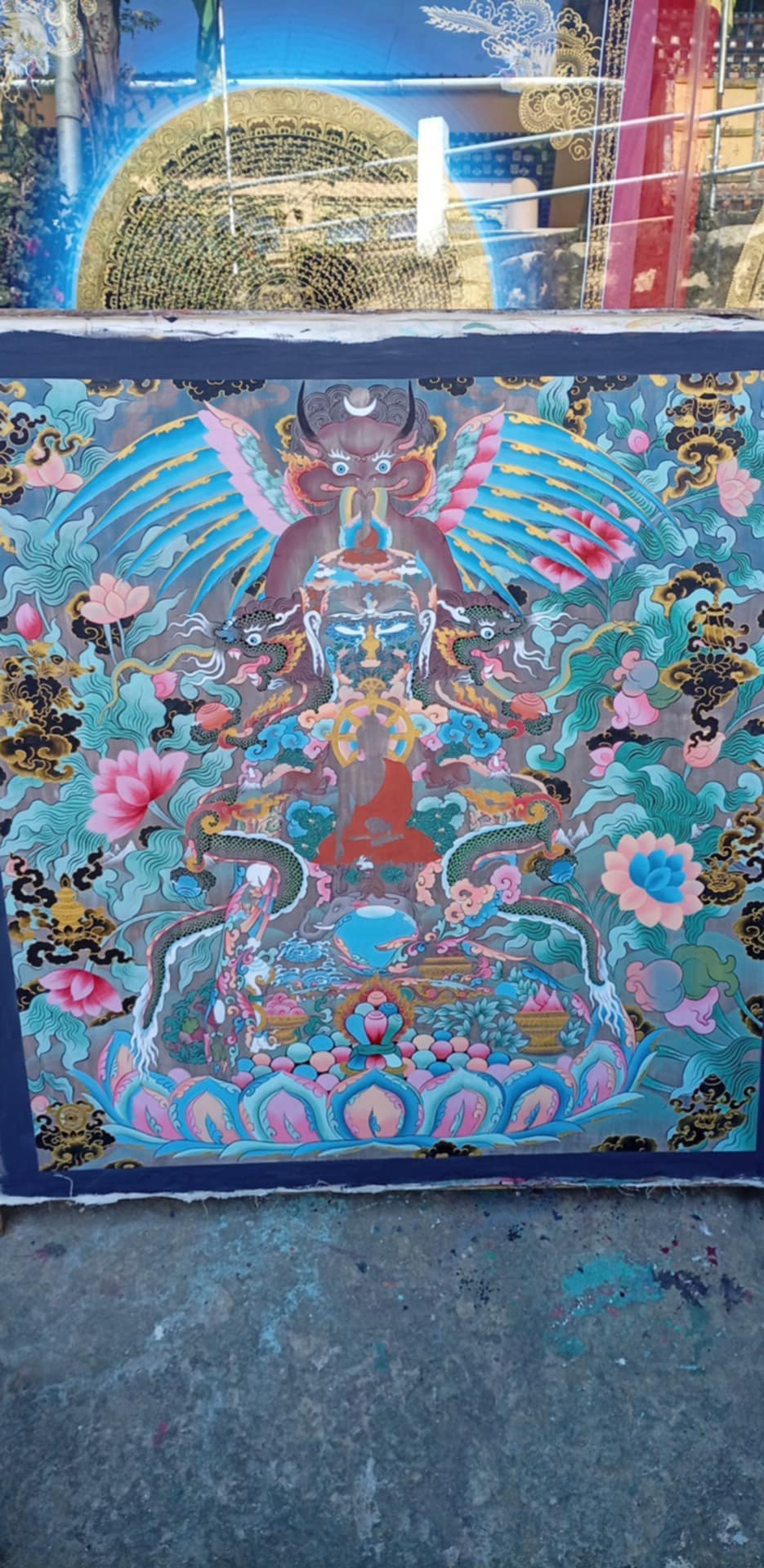
A protective thangka featuring the Garuda at the apex, holding a serpent in its beak. The composition brings together traditionally opposing forces—fire and water, bird and serpent—into harmonic unity, symbolizing the transmutation of poison into wisdom.
Detailed Explanation
This is a contemporary Tibetan Thangka painting depicting a complex, talismanic composition centered on spiritual protection and elemental balance.
The composition is dominated by three distinct tiers:
The Apex: The Great Garuda (Khyung)
At the very top sits the Garuda, a mythical bird-like creature revered in both Hindu and Buddhist traditions. In Tibetan Buddhism, the Garuda represents the wisdom that consumes the delusions of the mind. He is depicted here with large blue and turquoise wings, horns, and a wrathful face. He holds a snake (Naga) in his beak, symbolizing control over water spirits and subterranean energies.
The Flanks: The Turquoise Dragons (Druk)
Framing the central figure are two coiling dragons (one green, one blue). In Tibetan geomancy, the dragon represents the power of the earth and the sound of thunder (the voice of the Dharma). Their placement here suggests the "arms" of the composition, creating a protective circle around the center.
The Heart: The Meditating Buddha
In the center of the composition sits a red-robed Buddha figure, likely Amitabha or Amitayus. He is seated in the lotus position on a moon disc, emanating an aura of calm amidst the swirling energy of the creatures around him.
Symbolism and Meaning
This painting is likely a Geomantic or Protective Thangka used to harmonize the elements and offer protection. The Garuda and Nagas/Dragons are traditionally enemies, yet in this painting they are brought together in a symmetrical layout, representing the transmutation of poison into wisdom.